The Broadway Building, for the University of technology, is expressed as a singular sculptural object, and will become part of the university’s broader strategy to create a vibrant and connected education district.
Selected from over 60 entries in an international two-stage design competition, the design makes a clear statement as screens made of aluminum sheets are perforated with the “1s” and “0s” of the binary code and applied to the angled plates; so that the pattern created is a re-working of the binary sequence for ‘University of Technology Sydney Faculty of Engineering and information Technology’. 
Concealed within are 12 floor levels above ground, with another four levels below, for research laboratories, lecture theatres, seminar rooms, teaching laboratories, academic and administration offices and car parking. Publicly accessible uses include a lecture complex, student union and retail outlets located to activate street edges.

A crevasse-like linear atrium penetrates the basic volume both vertically and horizontally, around which the teaching, learning and social spaces are distributed for function and flexibility. The crevasse provides natural light and pedestrian access through the building, and directly links the UTS education precinct to the local neighborhood.

An extensive range of environmentally sustainable design initiatives make a substantial contribution to achieving best practice standards in the Faculty accommodation. The design targets a minimum 5-star Green Star rating, and is expected to deliver an energy saving of 30- 45%, a potable water saving of 20-30% and a 50% reduction in greenhouse gas emissions over benchmark tertiary educational buildings with similar functional spaces.

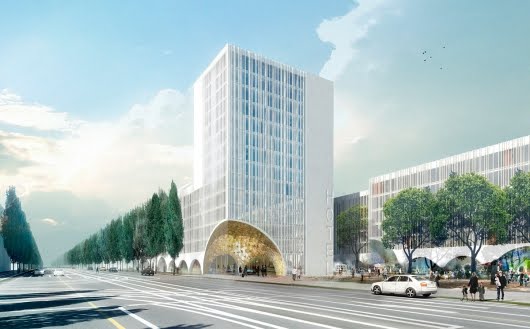 The design concept has its origin in three themes: the analysis of the historical city with its arches, vaults and arcades; a close relation to the masterplan with its boulevards, plazas and narrow streets; and a focus on human beings as well as the overall experience offered to the hotel guests.
 The arcade motif is well known in Munich and emphasizes the passage from a public plaza to the more private urban spaces creating a semi-public space where people can sit and observe the urban life. The design integrates this architectural feature into the ground floor level of the hotel.
 North and south of the building complex, two new urban plazas form natural entry points to the hotel. The entrances are accentuated in the building design by two impressive, specious golden vaults.
 The hotel rooms have been designed to become one-of-a-kind. By integrating large and luxurious bathrooms – as a kind of private spa-rooms – with daylight and visual connection to the outside greenery.
 The use of daylight is a general theme throughout the building complex. It offers the hotel guests a unique experience and sets a whole new standard for high-end hotels in general.


