Showing posts with label future design. Show all posts

7.2.13

James Law Cybertecture, Cybertecture Egg, Office Building, Mumbai

Are you familiar with the term “cybertecture”? Well, in case you are not, let me explain the concept to you, as simple as possible. Cybertecture, is the point where architecture, technology and innovative engineering get together, in order to sculpt the urban environment. 

James Law Cybertecture, Cybertecture Egg, Office Building, Mumbai
Pretty cool hah? Well, I sure think so.

Not so sure yet? Just check out the Cybertecture Egg, in Mumbai, India, an astonishing 33,000 square meters office space, stacked in 13 stories with highly intelligent building management systems and 3 levels of basement providing 400 car parking spaces.

James Law Cybertecture, Cybertecture Egg, Office Building, Mumbai
According to James Law Cybertecture, the Architects, (or should I say the Cybertects?), behind this impressive office building structure, the Cybertecture Egg is a Cybertecture building that brings together iconic architecture, environmental design, intelligent control systems, and evolutionary engineering to create the most innovative building for the city of Mumbai and for India in the 21st Century. 

James Law Cybertecture, Cybertecture Egg, Office Building, Mumbai
For more stunning pictures of this project you can visit the James Law Cybertecture site.

22.1.13

OFIS Architects, The Cultural Center Of European Space Technologies, Slovenia

Talking about future architecture, please, say hello to KSEVT, formally known as The Cultural Center of European Technologies in Slovenia. A place I had no idea even existed until I stumbled on this informative article on KNSTRT.
Would you ever guess that a tiny little Slovenia mountain village is the home to a ground breaking rocket engineer who pioneered theories on long-term human habitation of space? That’s right! Herman Potocnik Noordung, the first theoretician of space, was raised on the hillside of Vitanje. It is Potocnik’s theoretical work that brings the new Cultural Center of European Space Technologies (KSEVT) to the small town today.
OFIS Architects, The Cultural Center Of European Space Technologies, Slovenia


17.1.13

Soho Galaxy, Zaha Hadid Architecture, Urban Complex, Beijing


Our personal favorite Starchitect, Zaha Hadid, did it again!

This time one of her latest projects, the 330,000 square meter, Galaxy SOHO, urban complex, in Beijing, is nominated, for The Designs of the Year 2013 Awards, the so called "Oscars of the Design World". Way to go, Zaha!

Let's take a look at this one of a kind project, hot cup of coffee at hand and all...

One of the design concepts of the project is to create an internal world reflecting the theme of the Chinese courtyard.
Soho Galaxy, Zaha Hadid Architecture, Urban Complex, BeijingSoho Galaxy, Zaha Hadid Architecture, Urban Complex, Beijing

19.5.10

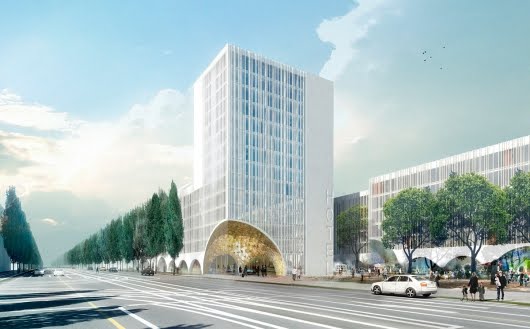
Schmidt Hammer Lassen Architects, Schwabinger Tor Hotel, Munich

The 40,000 m2 5-star hotel complex is situated in the newly developed Schwabinger Tor area, in Munich, Germany. The challenge was to bring the architectural characteristics of Munich into this new and modern part of the city.The design concept has its origin in three themes: the analysis of the historical city with its arches, vaults and arcades; a close relation to the masterplan with its boulevards, plazas and narrow streets; and a focus on human beings as well as the overall experience offered to the hotel guests.The arcade motif is well known in Munich and emphasizes the passage from a public plaza to the more private urban spaces creating a semi-public space where people can sit and observe the urban life. The design integrates this architectural feature into the ground floor level of the hotel.North and south of the building complex, two new urban plazas form natural entry points to the hotel. The entrances are accentuated in the building design by two impressive, specious golden vaults.The hotel rooms have been designed to become one-of-a-kind. By integrating large and luxurious bathrooms – as a kind of private spa-rooms – with daylight and visual connection to the outside greenery.The use of daylight is a general theme throughout the building complex. It offers the hotel guests a unique experience and sets a whole new standard for high-end hotels in general.

17.5.10

University of Technology, Denton Corker Marshall, Sydney

The Broadway Building, for the University of technology, is expressed as a singular sculptural object, and will become part of the university’s broader strategy to create a vibrant and connected education district.

Selected from over 60 entries in an international two-stage design competition, the design makes a clear statement as screens made of aluminum sheets are perforated with the “1s” and “0s” of the binary code and applied to the angled plates; so that the pattern created is a re-working of the binary sequence for ‘University of Technology Sydney Faculty of Engineering and information Technology’.

Concealed within are 12 floor levels above ground, with another four levels below, for research laboratories, lecture theatres, seminar rooms, teaching laboratories, academic and administration offices and car parking. Publicly accessible uses include a lecture complex, student union and retail outlets located to activate street edges.

A crevasse-like linear atrium penetrates the basic volume both vertically and horizontally, around which the teaching, learning and social spaces are distributed for function and flexibility. The crevasse provides natural light and pedestrian access through the building, and directly links the UTS education precinct to the local neighborhood.

An extensive range of environmentally sustainable design initiatives make a substantial contribution to achieving best practice standards in the Faculty accommodation. The design targets a minimum 5-star Green Star rating, and is expected to deliver an energy saving of 30- 45%, a potable water saving of 20-30% and a 50% reduction in greenhouse gas emissions over benchmark tertiary educational buildings with similar functional spaces.

3.5.10

Casa Son Vida, TEC Architecture, Mallorca

Located 15 minutes outside Palma de Mallorca, in an exclusive community called Son Vida, Casa Son Vida is an 800 square meter, luxury villa, marking the arrival of a new architectural approach to the island.

The luxury residence redefines luxury architecture featuring a variety of round and square shapes, futuristic blobs combined with antiques, mixing traditional and modern styles, resulting in a sophisticated futuristic structure.

While Mallorca is undeniably gorgeous, we felt there was a gap in the market,” explains Cosmopolitan president Michael Rimbeck.

“Most real estate on the island is predictable or inevitably Mediterranean. We wanted to offer the increasing number of young, progressive, and adventurous buyers who are attracted to the island a more daring and evocative alternative.”

Casa Son Vida will capture the attention of the international design world with its sophistication and vitality, making Mallorca a new destination for those in search of design exploration and inspiration.

13.4.10

Taipei Pop Music Center by Reiser + Umemoto

Pop music, while a global phenomenon, is regional in its definition. The Taiwanese Pop music scene typifies the phenomenon; while it crosses borders and cultures and dialects, it nevertheless has produced styles and genres with distinct transnational form and appeal.
Though many aspects of pop culture exist in a hyper-technological or virtual realm, there is a need for a defined physical hub dedicated to the production and reception of pop.
The Taipei Pop Music Center features a gradient of mixed-use spaces, from the fully public realm to the interior of the auditorium, allows the visitor to partake of the event dynamic however they choose to visit this complex. Whether they plan a night of music or are browsing the myriad shops, markets, cafes, and restaurants, the complex will be a 24-hour attraction independent of the schedule of performances in the theaters.
The TPMC features a new elevated public ground, which bridges the two building sites presently divided by Xinsheng Rd. Corridor. The elevated public space is a pedestrian zone creating a coherent public space distinct yet connected to the life of the city, and effectively joining the three major zones of the complex, the Main Concert Hall, Outdoor Amphitheater, and the Hall of Fame.
The public space is in itself a focus for outdoor events, surrounded by cafes, restaurants and shops. Here, the spectacle of pop music can be celebrated and broadcast to the world.

From: http://www.reiser-umemoto.com/


2.10.09

Foster+Partners Spaceport, New Mexico

Future and Architecture… Any ideas? Well it looks like the future is here, for Foster + Partners and URS corporation, who designed the first spaceport in the world, in New Mexico. And in case you were wondering, yes construction has already begun!

The sinuous shape of the building in the landscape and its interior spaces seek to capture the drama and mystery of space flight itself, articulating the thrill of space travel for the first space tourists.
Making a minimal impact on the environment, the scheme will be the first facility of its kind and a model for the future.
The spaceport will host commercial operations by private space travel companies, like Virgin Galactic.

Read more about Foster+Partners in Future Architecture:
Foster+Partners to connect North and South Korea
Masdar City - Foster + Partners

28.9.09

Santiago Calatrava does it again! Liège Train Station, Belgium

Calatrava’s Liège station began construction in 1996 and was designed to provide rail service for 36,000 people a day whilst introducing innovative design to the local area of Liège.

As a significant point of connection between not only local areas but European cities, the design for Liège-Guillemins Station aimed to create a symbol of the city’s renewal.

Calatrava designed a structure ‘without facades’ and focused on the roof as the key element within the design. It offers protection from the surrounding natural environment in the form of a glass and steel vaulted curve and stretches over five platforms.A series of pedestrian bridges and walkways at basement level provide access from one end of the station to the other.Santiago Calatrava said: “It was my goal to create a 21st century transportation facility that would not only unite Liège with the rest of Europe, but would also serve as a symbol of the city’s renewal. The project, as a whole, creates a new gateway into Liège and re-establishes a relationship with the city”.

24.9.09

Hamburg Philharmonic Concert Hall

So, what do you think of this building?
Well then, how about this one?
Yes, this is how the new Hamburg’s Philharmonic Orchestra Hall will look like, upon completion, in 2012.

Architects Herzog & de Meuron, designed the Elbie Hall, one of the largest urban construction projects under way in Europe, back in 2007. The design of the Philharmonic Hall will incorporate a pre-existing brick warehouse topped by a new crystalline tent-like structure that seems to float above the industrial base.
The Elbe Philharmonic Hall will become a cultural centerpiece for Hamburg and is destined to house one of the world's ten best concert halls, a 250 room five-star hotel, a wellness and conference zone, numerous restaurants and nightclubs and 47 owner-occupied apartments!

13.7.09

A new architecture award for Manitoba Hydro Place

is isn’t the first time the Manitoba Hydro Place, the 23-storey, energy-efficient building on Winnipeg, gets awarded, this time it was the Council on Tall Buildings and Urban Habitat's 2009 award for the best tall building in the Americas.Designed by Kuwabara Payne McKenna Blumberg Architects of Toronto and Winnipeg's Smith Carter Architects and Engineers Inc., the 690,000 square foot corporate headquarters of Manitoba Hydro Place, took 3½ years to complete at a cost of $300 million.Today Manitoba Hydro Place is one of the smartest structures in North America and one of the most energy-efficient office towers in the world with a plethora of automated and integrated building management systems coupled with innovative geothermal heating and radiant cooling systems.Ultimately, Manitoba Hydro Place sets a precedent for the seamless integration of architectural excellence and climate responsive, energy efficient and sustainable design while enhancing and improving the quality and comfort of the human experience and the civility of urban life.We are happy to discover that the next generation of sustainable buildings is already here, integrating time-tested environmental concepts and advanced technologies to achieve living buildings that dynamically respond to local climate.

7.7.09

Big Dig House - A testament of recycling

Today we will take you on a unique house tour, where future architecture is literally created with materials from the past.If you don’t already know the story behind the Big Dig House, the living proof that infrastructure materials can be salvaged and reused to create amazing structures, here is a short summary of its unique history.The house was designed by Cambridge architects Single Speed Design and was built using over 600,000 lbs of construction materials recycled from the Big Dig highway project in Boston. Steel columns, beams, concrete roadway etc from the demolished I-93 off-ramps were the primary materials of construction of this amazing house the cost of which did not exceed 150$ per square foot, since in most cases the owners only had to pay only for the shipping of the materials on site.A testament of recycling this 3,400 square foot house opens up a whole new chapter in eco living and future architecture techniques and as stated in the Single Speed Design website, "Most importantly, the house demonstrates an untapped potential for the public realm: with strategic front-end planning, much needed community programs including schools, libraries, and housing could be constructed whenever infrastructure is deconstructed, saving valuable resources, embodied energy, and taxpayer dollars."

3.6.09

AGO + Gehry = Stimulating Experience

It wasn’t long ago, when a very good friend of mine told me, that visiting the redesigned Ontario Art Gallery was one of the most rewarding experiences he had in the last years, in both art and architecture. He was fascinated with Gehry’s work and after taking some time navigating the net and looking for info on the new AGO, I was too. And if I know you well enough, you will be too.

After two long years of renovation, the Art Gallery of Ontario reopened last November and it was a triumph of redesign, inside and out and as stated in AGO’s website “When art meets architecture, powerful experiences take shape.”

Lets take a look at some of Gallery’s design highlights:

  • A new entrance aligned with Walker Court, the historic heart of the AGO, and The Grange, the Gallery’s first home
  • A glass and wood façade that spans 600 feet along Dundas Street and rises 70 feet above street level
  • A sculpture gallery that extends 450 feet, enabling visitors to see out onto Dundas Street, and passersby to see into the Gallery
  • A new, tinted titanium-and-glass four-storey south wing overlooking Grange Park that will house a centre for contemporary art and offer one of the most beautiful event spaces in the city
  • A south façade that complements the new Ontario College of Art and Design building to the southeast, with both buildings framing Grange Park
  • Extensive glazing on both the north and south façades to allow visitors to experience the surrounding cityscape from the Gallery interior
  • A sculptural staircase that soars from the second floor, linking Walker Court to the new centre for contemporary art and new event space
  • The integration of natural light throughout the building, including a new glass roof over Walker Court and a light-filled walkway around its upper perimeter, bringing light into the core of the building

The sculptural staircase rises from the second floor of Walker Court, through the glass ceiling and extends to the fifth floor. In designing the signature staircase, Gehry remarked that he hoped its warmth and intimacy would beckon visitors and become a place where people fall in love.

29.5.09

Zaha Hadid Architects – Towers, Cairo

Zaha Hadid architects have unveiled plans of The Stone Towers - a 525,000sqm office and retail complex for the rooya group, in cairo, egypt.

A five-star business hotel with serviced apartments, retail with food and beverage facilities and sunken landscaped gardens and plaza called the 'delta' is also included in the development.

Inspired by the patterns and textures of ancient Egyptian stonework, the north and south facades of each tower will be covered with recesses and protrusions emphasizing the effects of light and shadow on the surfaces.

From Zaha Hadid Architects:

STONE TOWERS, CAIRO BY ZAHA HADID ARCHITECTS

‘The Stone Towers by Zaha Hadid Architects for Rooya Group of Egypt is located in the Stone Park district of Cairo. Providing office and retail facilities to a rapidly expanding Cairo, the unique 525,000sqm Stone Towers development also includes a five-star business hotel with serviced apartments, retail with food and beverage facilities and sunken landscaped gardens and plaza called the ‘Delta’.

Ancient Egyptian stonework incorporates a vast array of patterns and textures that, when illuminated by the intense sunlight of the region, creates animated displays of light and shadow. The effect is powerful, direct and inspiring. The facades on the North and South elevations of each building within Stone Towers adopts a rich vocabulary of alternating protrusions, recesses and voids to enhance the deep reveal shadow lines that accentuate the curvatures of each building within the development and animate the project throughout the day.

‘I am delighted to be working in Cairo,’ states Hadid. ‘I have visited Egypt many times and I have always been fascinated by the mathematics and arts of the Arab world. In our office we have always researched the formal concepts of geometry - which relates a great deal to the region’s art traditions and sciences in terms of algebra, geometry and mathematics. This research has informed the design for Stone Towers.’

Client: Rooya Group
Architect: Zaha Hadid Architects
Structural Engineer: Adams Kara Taylor
Gross Building Area: 525,000 m2
Site Area: 170,000 m2

More Zaha Hadid in Future Architecture:

London Aquatics Centre

Regium Waterfront Museum, Italy

Antwerp Port House